01
Protect patients and institutions
Identify unsafe assumptions, weak validation, bias, drift, cyber exposure and workflow failure before technical performance turns into clinical, legal or organizational harm.
AICDRM™ prepares senior professionals to evaluate, authorize, govern and defend high-stakes healthcare AI decisions across patient safety, validation, malpractice, regulation, cybersecurity, vendor risk, governance and insurance.
Built for physicians, medical schools, universities, researchers, hospital and clinic leaders, healthcare attorneys, law firms, insurers, physician assistants, experienced specialist nurses and healthcare IT leaders.
Discounts do not stack. The best eligible rate is applied. Group pricing is per seat with a minimum purchase of three seats.
AICDRM is designed for the people who may ultimately have to approve an AI system, challenge it, insure it, defend it—or stop it. The program is not limited to model performance; it focuses on whether an AI-supported decision can be clinically, legally and organizationally defended.
Identify unsafe assumptions, weak validation, bias, drift, cyber exposure and workflow failure before technical performance turns into clinical, legal or organizational harm.
Build a common decision language across medicine, law, operations, risk, insurance, vendors, IT and boards so AI governance is not delegated blindly to one function.
Build evidence-linked artifacts and a final Clinical AI Safety Case™ that supports approve, condition, pilot, pause, reject, rollback or retire decisions.
Eligible tuition can be refunded when requested within 14 days after the later of the purchase date or the October 15, 2026 cohort start, provided no more than 20% of the course has been substantially completed and no certificate has been issued. Group seats follow the same rule for the affected seat.
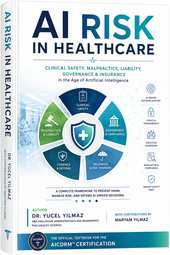
Official AICDRM™ course textbook
Integrated into weekly study and the evidence-grounded learning environment.
The objective is not to turn a physician into a programmer, an attorney into a data scientist or a CEO into an engineer. It is to give senior professionals enough cross-disciplinary command to recognize weak evidence, ask better questions, challenge unsafe assumptions and participate credibly in decisions that may affect patients, institutions and financial risk.
Check professional eligibility and your automatic launch rate, then continue to secure LIVE Stripe Checkout. Institutional buyers may purchase three or more group seats at the published group rate.